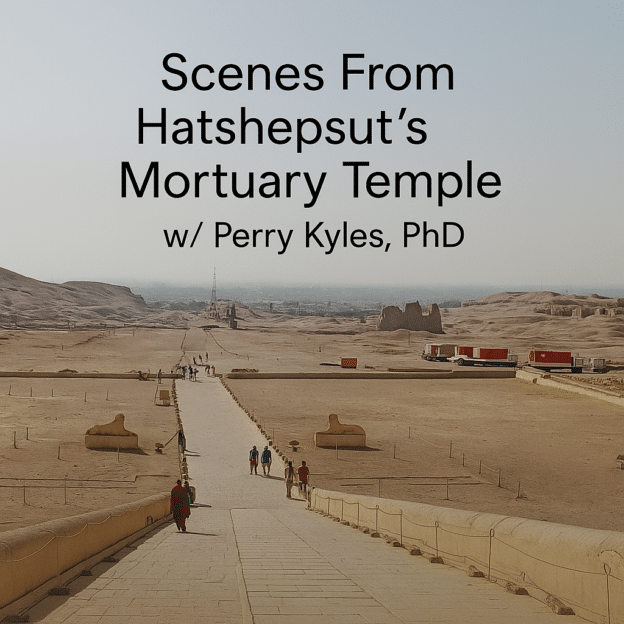
Scenes From Hatshepsut’s Temple In Deir el-Bahari In Luxor, Egypt
Hatshepsut didn’t just build a temple — she carved an idea into the cliffs of Luxor. She rose to the throne of Kemet and declared her divine right to rule. This sacred terrace is her stage, her sanctuary, and her architectural masterpiece.
In this video, you’ll step inside her world with me. This isn’t just a tour clip — it’s a window into the mind of one of the greatest leaders to ever shape human history. Press play and feel the power of Hatshepsut for yourself.
Family, we have spent generations watching the world take from us without hesitation. It took our labor and built empires on our backs. It stripped us of our names and attempted to erase our identities. It stole our inventions and paraded them as the achievements of others. It distorted our image and offered us caricatures in place of our reality. It even attempted to seize our gods, claiming our sacred traditions while denying our connection to them.
Family, we have spent generations watching the world take from us without hesitation. It took our labor and built empires on our backs. It stripped us of our names and attempted to erase our identities. It stole our inventions and paraded them as the achievements of others. It distorted our image and offered us caricatures in place of our reality. It even attempted to seize our gods, claiming our sacred traditions while denying our connection to them.
Yet despite all that has been taken, a simple truth remains: no one can permanently steal what a people choose to reclaim. Once memory awakens, once identity stabilizes, once a community recognizes the depth of its own inheritance, the theft loses its power. What was interrupted can be restored. What was buried can rise again.
And that raises the question: What exactly are we reclaiming?
We are reclaiming the First Throne—the intellectual, spiritual, and cultural legacy of Kemet, which stands as one of humanity’s earliest and most sophisticated civilizations. Kemet is not an abstract historical curiosity; it is the foundation upon which so much of global thought, science, philosophy, and governance is built. It represents the original articulation of order, morality, innovation, and communal responsibility. It is, in a very real sense, our inheritance.
Ma’at provides the structural framework for that inheritance—truth, balance, harmony, reciprocity, justice, righteousness, and cosmic order. These principles are not foreign concepts; they are deeply aligned with the intuitive ethics that guided our ancestors long before forced conversions and cultural disruptions took place. When I speak of the ancestors as our teachers, I am referring to that memory, that reservoir of knowledge that continues to press against our consciousness even when society insists on distractions and distortions.
Reclaiming our inheritance requires us to stand firmly inside our original cultural genius. That means we do not need to borrow our identity from Europe or shape our worldview around Arabia. We do not need to chase validation from cultures that historically extracted from us while denying our humanity. Our path forward does not depend on conversion to foreign gods or assimilation into foreign traditions. Instead, it depends on remembering that we already come from a complete, sophisticated, world-shaping tradition. The work is not to adopt something new—it is to recover something ancient.
This is particularly important for Foundational Black Americans. When we ask, “Who are we?” the answer is not found in the labels imposed on us through captivity. It is found in the continuity of cultural instincts that refuse to die: our drive for creativity, our instinct for justice, our spiritual intuition, our communal ethic, our intellectual curiosity, and our refusal to bow to systems that attempt to diminish us.
So again, who are we?
We are the descendants of the world’s first civilization, the inheritors of a legacy that predates the empires that later claimed authority over us. And what do we follow? We follow Kemet—the original way, the foundational structure that centered humanity, order, wisdom, and divine balance long before borders and religions redrew the map.
When FBA stands in truth—when we embrace our cultural foundation rather than adopting identities crafted by others—the world feels that shift. It disrupts narratives. It unsettles those who depend on our disorientation. It shakes assumptions that have stood for centuries. And yes, in a very real sense, the whole world shakes when the children of the First Civilization remember who they are.
BLACKS & CHRISTIANS MAINTAINED THE LEGACY OF KEMET
In the last decade, a new confidence has swept through some circles in modern Misr. You hear it online, in the streets, in the cafés, and especially in the comment sections: “We are the Pharaohs. We built the pyramids. Kemet is ours.” These declarations come with an air of certainty so intense that anyone who questions them is treated as an enemy, especially if that person is a Black descendant of the African civilizations that shaped the Nile Valley long before Arabic even existed.
But let us speak plainly: this is a retroactive claim, not a historical one. It is a nationalistic costume worn today, not a cultural inheritance preserved over the centuries. And the historical record — the actual documented behavior of the rulers and populations of Misr for over a thousand years — exposes the truth with clarity.
For most of their history under Arab rule, the people now claiming Kemet did not love it, did not protect it, and did not identify with it. The ancient temples, pyramids, statues, and sacred spaces that the world reveres today were, for centuries, treated not as cultural treasures but as pagan remains. The modern claims only became loud once Kemet became profitable — once tourists, scholars, and the global imagination elevated these relics to world significance.
To understand how deep the disconnect truly is, consider the most striking example: Al-Aziz Uthman, the son of Salah al-Din. In the 1190s, he ordered his men to destroy the pyramids, beginning with the Pyramid of Menkaure. This was not an accident. It was not neglect. It was a deliberate attempt to erase the civilization that many in Misr today suddenly insist they descend from. His workers tried for months, chiseling away at casing stones that ancient Africans had engineered far beyond the abilities of their medieval attackers. They failed, but the scars they left on the pyramid remain as a permanent record of their contempt.
This episode is not an isolated moment of fanaticism. It reflects exactly how ancient Egypt was viewed by the rulers of Misr for centuries. Pyramids were seen as monuments of disbelief. Temples were considered places of sorcery. Hieroglyphs were believed to be magical spells. The ancient Egyptian language was allowed to die without a single institution stepping forward to preserve it. The culture that modern Egypt markets to the world existed, for most of Arab Egypt’s history, in the shadows — unloved, unclaimed, and undefended.
And while this neglect was unfolding in Misr, there were three groups who kept the flame of Kemet alive.
First, the Coptic Egyptians, whose language is the last surviving form of ancient Egyptian, preserved in their church liturgy long after official institutions abandoned it. The Copts carried linguistic DNA that links directly back to the temple walls.
Second, the Nubians, whose kingdoms continued building pyramids and honoring Nile valley traditions long after Egypt had turned away from its own past. In many ways, Nubia preserved the spirit of Kemet more faithfully than Cairo did for centuries.
Third — and perhaps most ironically — Black people across the African diaspora, especially in the United States and the Caribbean, defended Kemet’s African identity when almost no one else cared. Frederick Douglass, Martin Delany, and later generations of Afrocentric scholars honored and studied Kemet at a time when many Egyptians were still afraid to walk inside a temple at night.
So when certain voices in modern Misr declare an intellectual war on Black people for acknowledging the African roots of Kemet, they are waging war on historical truth. They are attacking the very communities that preserved the memory they now attempt to monopolize. And they are claiming a heritage their own ancestors tried to bury, tear down, or ignore.
Modern Egyptians have every right to take pride in the monuments that stand on their soil. Pride is human. Nationalism is powerful. But pride does not rewrite history. Geography does not equal lineage. And shouting does not create a connection where centuries of cultural rejection left a void.
Kemet was never “lost.”
It was ignored — until the world reminded Misr what stood in its own backyard.
The people who now try to silence Black voices speaking on Kemet have inherited a land, not a tradition. Yet they direct their hostility not toward the erasure committed by medieval rulers, not toward the colonial powers who stole monuments and mummies, but toward the very descendants of the African world that gave Kemet birth.
If they insist on intellectual war, then the battlefield will be history itself — and history is not on their side
Brothers and sisters, if you are holding all of your liquid assets in the bank, you might as well set a few thousand dollars a year on fire. Those that know better are buying gold. Data for the video came from microtrends.net and goldprice.com. The study contrasts the plight of John Wise and John Doe.
Gold vs. Bank Savings (Jan 2020 – Sept 2025)
In January 2020, they took divergent financial paths. John Doe placed $20,000 into a Bank of America Gold Tier savings account earning 0.02% APY, while John Wise invested his funds in 12 once-ounce Gold American Eagle coins purchased at $1,500 per ounce — a total of $18,000 in gold plus a modest premium.
At the time, both men felt secure. John Doe took the most common approach of relying on the bank, and John Wise trusted gold’s historical performance. But as inflation accelerated during and after the pandemic, the outcomes began to diverge dramatically.
2020: The First Split
By the end of 2020, the price of gold had climbed from $1,500 to $1,893 per ounce, raising the value of John Wise’s 12 coins to about $22,724. Meanwhile, John Doe’s savings account had grown only a few dollars to $20,004 nominally, but once adjusted for inflation, its real purchasing power had slipped to $19,725.
2021–2022: Inflation Accelerates
Through 2021 and 2022, inflation surged, eroding the value of cash faster than bank interest could compensate. This occurred because the American banking sector printed money hand over fist to save the privileged sectors, like the airlines. The purchasing power of John Doe’s $20,000 from January of 2020 dropped to $18,440 in 2021 and dropped further to $17,324 in 2022. Gold, meanwhile, dipped slightly in those years, hovering around $1,825 per ounce, keeping John Wise’s holdings near $21,900 — still well above his original cost.
2023–2024: Diverging Paths
By 2023, the American people began to pay the price for bankers’ incessant money printing. Inflation persisted and gold began to climb again, reaching over $2,060 per ounce. John Wise’s coins were now worth about $24,755, while John Doe’s inflation-adjusted savings had fallen below $16,800. In 2024, gold broke through the $2,600 level, pushing John Wise’s holdings to $31,281, whereas the real value of John Doe’s $20,000 savings dwindled to just $16,204.
2025: The Great Divide
By September 2025, gold prices surged to around $3,833 per ounce, giving John Wise’s 12 coins a total market value of roughly $45,997. John Doe’s account, despite compounding slightly to $20,024, lost $4,200 in purchasing power.
Conclusion
Over nearly six years, John Wise’s gold coins appreciated by more than 150%, while John Doe’s bank savings lost about 21% of its purchasing power. History has proven that cash preserves dollars; but gold preserves purchasing power!
This presentation was inspired by the Sudanese people that I met while in Egypt. They know they that are the true descendants of the pharaohs, however the modern Egyptians are darn near ready to fight when the truth of Kemet’s African origins is mentioned. I’ll address their reasons for this is another presentation. Today, I’ll make it clear that the pharaonic culture came into Egypt from the place that the Arabs named Sudan, which in Arabic means “Land of the Blacks”. You might also want to see my video called “Ethiopia and The Gift of the Nile”. I’ll put the link in the description box.
There are a few important details that it would benefit you to know. Firstly, the Africans of Sudan fought off the Romans that ruled Egypt after the Greeks. Also, Sudan fought off the Arab hordes until the early 16th century – nearly 1000 years after Egypt gave way to the Arabs.
The second detail of extreme importance is that there is a hugely significant difference between the borders of Ancient Kemet with Ancient Nubia, and the border of modern Egypt with modern Sudan. Borders in Antiquity were not as rigid as they are today. Throughout most of Ancient History the border between these two lands was the 1st Cataract. In 1899 Arabic Egypt, along with their British overlords, moved the border 168 miles/270 kilometers south into Sudan. Consequently, land that had been Sudanic became modern Egyptian. From their the Arabs and their overlords shamelessly began to revise history.
THE EVIDENCE FROM QUSTUL
Qustul was an archeological site that was in Sudan before the border was moved in 1899. It is now within the border of modern Egypt. The early civilizations of Qustul had a great cultural influence on Kemet. One of these influences is the concept of divine kingship, which means that the Pharaoh was thought of as a divine representative of God – he is “Heru on Earth”. Kemet was an elaboration of the political entities that emerged in the lands south of the Ancient border like Qustul – not a culture that emerged from the Asia.
The representation of the king as a hawk also has a Nubian origin and the best evidence for this was found in a cemetery in Nubia in 1964 by Keith Seele. This cemetery is underwater today because of the building of the High Aswan Dam that was finished in 1970, however the evidence supports the conclusion of an “up south” origin of Kemetic civilization and Pharaonic rule. An incense burner was found at Qustul that has several images that provide insight into the world of Pharaonic culture. It is generally accepted that the incense burner is about 800 years older than the accepted date of 3100 BC, which is commonly accepted as the date that the two lands of Kemet were united. From the left to the right, the incense burner possesses images of a serekh, which is a symbol for kingship that was later borrowed by Kemites. You can also see a bound captive. Next a man is wearing the crown that would later be used as the crown of Upper Egypt. The beard is apparent and so is a flail. Just in front of him is a hawk standing atop a castle is a symbol of kingship. If you are ever in Chicago, Illinois in the United States you should see the Qustul incense burner for yourself at the Oriental Institute Museum.
THE GEBEL SHEIKH SULEIMAN RELIEF
There are other pieces of evidence that suggests a movement of pharaonic culture down the Nile from modern Sudan to what is today called Egypt. The Gebel Sheikh Suleiman relief that was found in Sudan about 49 kilometers/30 miles south of Qustul is one of the Sudanic monuments that provides valuable information. On the monument, from the left to the right, there is a hawk atop a castle, a bound captive who is bound with the symbol for Ta Seti “Land of the Bow”, and also there appears to be two birds atop what became the hieroglyphic determinative for “city” or “state”. The art features slain enemies, just as it would hundreds of years later in Kemet.
THE BULL PALATTE
Some of the same iconography is featured on the Bull Palette, like the serekh and the hawk. There appears to have been competition for rulership between centralized states throughout the region. These competing states appear to have used the same iconography for kingship, like the hawk and the bull. This indicates that there was an extremely long cultural history that emerged throughout the region, long before the artifacts that we have found. A clear example of this is the similarities between the Bull Palette, which is currently housed at the Louvre Museum in Paris, France and the Narmer Palette, which you will see when you visit the Cairo Museum in Cairo, Egypt. Both of these artifacts are thought to have been used as palettes to mix makeup.
The Bull Palette is thought to have been created in the centuries leading up to the 1st Dynasty, which began when Pharaoh Narmer united “The Two Lands”. The obverse side of the palette features a fortified city or state with a lion and a vessel, or vase, inside. I surmise that this indicates an area that is protected by a monarch, and also the presence of a settled community. On the front side at the bottom appears to be a fortified city with a bird within it. It is difficult to determine since the palette has been broken and the whole of it cannot be pieced together. Near the top on this side of the palette is a vivid image of a bull killing a man. This symbolizes a king destroying his enemies.
The reverse side depicts this same scene of the bull vanquishing his enemy. The only difference is that the head of the enemy can be seen. This appears to be a foreigner from outside Africa, as indicated by the enemy’s hair. The vanquished man has hair quite similar to the Asiatic captives featured at the entrance of Ramses ll temple at Abu Simbel. This same enemy is depicted towards the bottom in a vulnerable position. Towards the center of the reverse side there are five images all of which are connected to a rope by an arm and fist. The first two are two hippopotami, the third is an ibis bird, which was anthropomorphized as the deity Djehuty, who is most often referred to by the Greek variant Thoth. The fourth is the Heru/Horus falcon, and the fifth is thought to be a symbol for the deity Min. The Bull Palette was found at Nekhen, which is currently known by its Greek name Hierakonpolis.
THE NARMER PALETTE
The Narmer Palette was found in the same city as the Bull Palette; however, it relates to a time after the Bull Palette. On both sides of the Narmer Palette, towards the bottom, there is a bull ravaging his enemies. It is apparent that these men are the same enemies that are towards the bottom of the Bull Palette. There is a serekh at the top of both sides in the center. In this serekh is the hieroglyphic spelling of the name “Narmer”, with the catfish making the sound “nar” and the chisel making the sound “mer”. The center of the palette depicts a dramatic scene of Narmer holding an enemy by the hair with his left hand, while holding up a mace with his right hand. Here he is wearing the “hedjet”, which is the bulb-like white crown of Upper Kemet. On this side, there is also a picture of a hawk holding a tool that is forced into the nose of an enemy. This enemy is thought to be from a marshland, perhaps near the mouth of the Hapi, where it flows into the Mediterranean. On the reverse side of the palette, Narmer is presented with the “deshret”, which is the red crown of Lower Kemet. Before him are four standard bearers with an animal skin, a canine, and two hawks. Once again, there is a serekh with a hawk on it. What follows next is a slew of dead bodies, presented in a way that signifies bodies slain in war. You must see this palette for yourself at the Cairo Museum!
The artifacts reveal that even though there may have been rival kings that were competing for dominance, the hieroglyphs and concepts that were associated with Kemet existed long before Kemet came into existence – long before Narmer united the two lands. If you look just beyond the smoke screen that was created by western and Arabic Egyptologists it becomes apparent that the Nubians of Ta Seti and Sudan are the true descendants of Kemet. The absurd claim of a mixed-race oasis emerging out of nowhere in Africa is only anti-black propaganda.
Let us begin by defining both Pan-Africanism and FBA. From there we’ll explore the conflict between the two and examine why this conflict has emerged. Also, I’ll issue a verdict as to which is the correct path as we move forward.
There are two major tenets of Pan-Africanism. The first is that all black people are united by the African bloodline. The second tenet is that members of this race should unite on a global scale to liberate the African diaspora from inhumanity and bigotry.
The energy, the finance, and the intellectual capital that has been used to promote the pan-Africanist movement has largely come from the West, particularly among the FBA. For example, David Walker. An FBA from North Carolina with pan-Africanist leanings. He published a book in 1829 called, Walker’s Appeal to the Colored Citizens of the World, but in particular and very expressly to those of the United States of America. The pan-Africanist movement is not centralized, although attempts have been made in the past by activists like Marcus Garvey. Garvey was a Jamaican that was based in the United States. I am a Pan-Africanist.
Over the course of my adult life, I’ve had the opportunity to have lengthy stays in Europe, Asia, and Africa. In every single place I’ve been. A white life is more valuable than a black life in all of those locations, including continental Africa. And a white man’s ice is viewed as being colder than a black man’s ice. Therefore, I have some idea of what Marcus Garvey saw as he traveled between the Americas and Europe. The pan-Africanist goal of black unity is a logical step, and that’s what he saw. This is why Babylon fears a successful Pan Africanist reality.
To get a clear understanding of FBA. I visited a website called Foundational Black Americans at officialfba.com. It does not clearly state who the operator of the site is, but I get the impression that the operators of the site follow the popular FBA movement. FBA is not an organization and there is no designated leader of FBA. According to the site, and I quote, FBA is a lineage based designation that specifically refers to the over 43 million black American who are direct descendants freed men, the formerly enslaved black people who were emancipated in the United States. This lineage represents a unique and unbroken connection to the foundational builders of this nation. Now that would include people like Crispus Attucks, the very first man to die in the American War for Independence from Great Britain. The great 19th century liberator Harriet Tubman would also be included in that lot; baseball legend Jackie Robinson, who integrated baseball, and current congressional member Jasmine Crockett. I am a genetic FDA. There is a glaring problem, however, with the FBA movement, and I’ll address that later.
Both Pan-Africanism and FBA focus on lineage. Pan-Africanism covers a broader geographic and historical canvas, while FBA narrows the lineage to those blacks whose ancestors were in the United States before the abolition of slaves.
The history of Pan-Africanism in Africa is quite ironic. The irony is that the people that have the most to gain from it, such as the continental Africans, are the least likely to adopt it. Throughout the 20th century, African countries achieved de jure independence from their colonial overlords. They carried over their most destructive problems with them into independence. They never shared the cloaks of tribalism, Eurocentrism, and corruption. One example is the economic community of West African states, which was established in 1975. The organization has regressed over the course of the last 50 years and has yielded no fruit as of late. The chair of ECOWAS is the Nigerian president, Bola Tanub. He’s the leader of the organization and he’s run it poorly, just like he’s led his country, extremely poorly. Nigeria, which has the largest population in Africa and is the country’s largest oil producer, is still crippled by rampant corruption, inflation, and security threats. Africa’s former colonizers along with African leaders have poisoned the minds of the Africans and have launched them out into the world at us like little missiles of colonialism but in blackface.
Since slavery was abolished in the United States, it seems like black Americans have put Pan-Africanism into action and we have fought tirelessly for Africans. For example, in 1890, it was an FBA named George Washington Williams that called attention to the gross abuses against Africans in the Congo Free State. It was an FBA led organization named Trans Africa that viewed the anti-apartheid movement that eventually led to the fall of state sanctioned apartheid in South Africa.
If there’s any group that can use some pan Africanism right now, it is the continental Africans. Africans devalue African life and culture in many ways. One of the most telling and heartbreaking is the mutilation that Africans undertake to lighten their skin color. According to Google, the market for cream and lightening creams was $239 million in 2021. And it is expected to eclipse 500 million by 2033. According to the World Health Organization, 70 % of women in Nigeria have used skin lightening cream. Now of all places in which you should be able to be black, Africa is that place! Yet they cling to that old colonial mindset like it’s a bag of fresh Indian hair.
FBAs should fervently oppose pan-Africanism in their country right now. The USA has been the land of opportunity for foreigners from all over the world, especially since the FBAs have made America safe for blacks, reds, browns, yellows, alternative lifestyles, Muslims, and whoever else. The freedoms that they enjoy were achieved on the backs of all the Americans who fought for the country and the FBAs that led the Civil Rights Movement. It is the FBAs that have challenged the USA to respect its own laws. The problem with this scenario is that the blacks, reds, browns, yellows, muslims, etc. come from countries whose culture encourage a rigid racialized hierarchy. These beliefs are firmly planted in their spirits. They hate black. They don’t respect the humanity of the black people in their own countries. Furthermore, because of colonialism and imperialism, many of these folks see themselves as mascots for the Blancos. They should form their own rainbow coalition called Mascot for Mayo. Just look at this map of the countries that have been under European colonial rule. They cursed the gods of their native lands and they have been socialized to prioritize the interests of their colonial masters, even at their own expense.
Right now, the genetic FBAs are shooting themselves in the foot when they promote lax immigration policies or accept no policies at all. For Black America, the fruits yielded by Pan-Africanism have been unidirectional instead of mutually beneficial. FBAs that campaign for millions of these male supremacist foot soldiers to enter the country are politically immature. FBAs have enough work to do against the traditional enemies of humanity. Empowering a rainbow coalition of male supremacists only makes the work more difficult. Our politicians pretend to care about the masses. The economic and social impact of importing droves of anti-black foot soldiers will be the most detrimental to FBAs that are either young or working their way out of poverty.
Historically, FBAs have not had qualms with Caribbean or African people. In general, we have celebrated their differences. Over the years, I’ve realized that the acrimony and contempt has mostly gone in one direction, from Black foreigners to FBAs. When our labor bears fruit, these foreigners are Black. When it is time to stand up to injustice, they are quieter than a call girl in church service. But that is not the worst of it. If they had quietly accepted the benefits that FBAs earned, FBAs probably would never have said anything. However, that colonial training is just too powerful in their spirits. Instead of love or indifference, they come with malice towards FBAs.
FBAs should not take the disrespectful of immigrants personally. It is not because FBAs are lazy, violent, or decadent. The countries that they flee are more violent and more deviant than the FBA community. Their problem with you is that they see you as a privileged black. They are envious. They bring that anti-black “mayo supremacist” mindset with them and do their best to undermine the very same people that has always fought for them and continues to fight for them. They bring the same mentality that has ruined their countries and spread it like tuberculosis. They think they are being clever, but they are essentially being two-faced.
I think the FBA movement should be more explicit. To say that it is simply a matter of delineation sells the movement short. There are droves of genetically FBA people that oppose the premise of FBA. One reason for this is their naivete. They are wedded to the notion of a single collective black people. The other reason why genetic FBAs do not support the FBA movement is their allegiance to “mayo nation” and are the Democratic Party. Blacks should definitely split with the Democrats on the issue of immigration and explicitly politicized FBA movement has as much of a right to exist as LULAC, the Anti-Defamation League, or the NAACP. To me, explicit politicization is the obvious next step.
In closing, I’ll say that this particular moment in history, Pan-Africanism is needed in Africa and the Caribbean. However, in America, it is exploited to the detriment of Foundational Black Americans. It is time for Black Americans to get their heads out of their backsides and strategize against the rainbow coalition of male supremacists, particularly those that use God’s gift of melanin as a camouflage to do their colonizers bidding.
FREE SHIPPING ON ALL ORDERS
98% of our orders are shipped within 2 business days