
Dr. Kyles shares insights and images on menkaura’s pyramid and the 3 pyramids south of his that are commonly accepted as belonging to his wives.
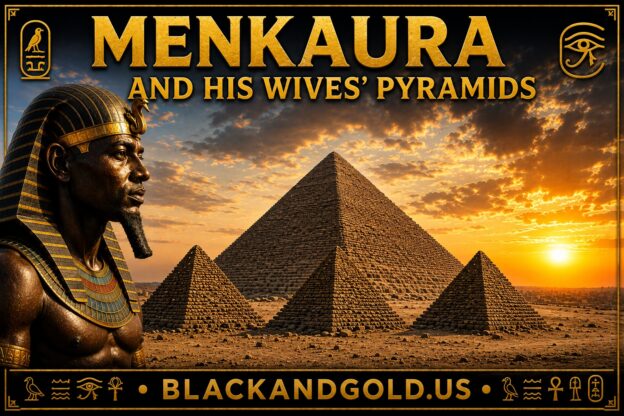
Menkaura’s Pyramid and His Wives’ Pyramids
Leave a reply
Dr. Kyles shares insights and images on menkaura’s pyramid and the 3 pyramids south of his that are commonly accepted as belonging to his wives.

What if everything you thought you knew about African history was just the tip of the pyramid?
When we celebrate Black History, we often start with struggle. But the truth is, Black history begins with greatness—with a civilization so advanced that it became the foundation for countless cultures across Africa and the world.
That civilization is Kemet—the land the Greeks later renamed Egypt.
Long before Europe’s rise or even the idea of the West, there was Kemet—the “Black Land.” It was not only a nation of pyramids and pharaohs, but a living university of astronomy, medicine, art, engineering, spirituality, and law.
This was not a civilization in isolation. Its influence radiated like the sun across the African continent. Through migration, trade, and spiritual exchange, Kemet seeded timeless traditions into neighboring kingdoms, especially Nubia, Kush, Axum, and even as far west as Ghana and Mali.
Kemet wasn’t just Africa’s past. It was—and still is—Africa’s backbone.
The spiritual systems of Africa didn’t emerge randomly. Many of them reflect the sacred principles first recorded on the walls of Kemet’s temples.
Take Ma’at, the Kemetic concept of balance, truth, and cosmic order. You’ll find echoes of Ma’at in the moral teachings of the Yoruba, the cosmology of the Dogon, and the ancestral reverence of the Akan. Kemet taught that the soul’s purpose was to live in alignment with the divine—a truth still honored today in African spiritual practices across the globe.
The afterlife beliefs, use of sacred symbols, ritual storytelling, even the wearing of certain colors and regalia—many of these stem from Kemet’s spiritual science.
The concept of divine leadership—where the ruler is both political and spiritual—didn’t die with the Pharaohs. It migrated. The idea of sacred kingship appears in ancient Ethiopia, among the Ashanti of Ghana, and in royal systems from the Congo to the Zulu Kingdom.
African languages, too, carry the linguistic fingerprints of Kemet. From shared word roots to cosmological terms, Kemet’s intellectual legacy is quietly embedded in the very languages people speak to this day.
And the art? From West African masks to Nubian jewelry, the influence of Kemetic aesthetics is undeniable. The symbolism, symmetry, and spiritual purpose in African art all echo Kemet’s visual language.
The erasure of Kemet’s African roots wasn’t accidental. For centuries, the idea that Africans could have built such a brilliant civilization was downplayed—or outright stolen.
But the truth is rising. Rediscovering Kemet isn’t just an academic pursuit—it’s a reclamation of identity.
Understanding this connection transforms the way we see Africa—and ourselves. It tells our children that their history doesn’t begin in chains. It begins in crowns, temples, and stars.
Want to do more than just read about this history? Walk it. Touch it. Feel it.
Join us on the Kemet 101 Educational Tour to Egypt with Dr. Perry Kyles—a 12-day journey through ancient temples, sacred tombs, and living history. This isn’t a vacation. It’s a spiritual return. It’s your personal reconnection with the roots of Black brilliance.
🛕 Experience the real Kemet. Feel the truth for yourself.
👉 Book your place on the Kemet 101 Tour
📚 Learn. Reclaim. Awaken.
Walk into most schools today and you’ll likely hear that civilization began in places like Mesopotamia or Greece. You’re taught that science, mathematics, medicine, and philosophy were European contributions. But if you’ve been studying African Origins seriously, you know that narrative doesn’t hold up.
The truth is, long before Greece, long before Rome, long before the so-called “cradles of civilization,” there was Kemet.
Kemet is the name that the ancients used to describe their land. It means “The Black Land.” Now, some say this referred to the fertile soil of the Nile Valley. But those of us who have studied the people, the culture, and the legacy of Kemet know it was also a reference to the people themselves. They were Black. They were African. And they were brilliant.
This is the story they don’t teach you in school. But it’s written in stone.

If you’ve ever stood before the Great Pyramid, you understand this wasn’t built by guesswork or superstition. The builders of Kemet understood geometry, engineering, astronomy, and logistics. Every stone was placed with intent. The alignment of temples and pyramids with the stars is not coincidental. It reflects a scientific understanding that predates the Greek world by thousands of years.
We are often told that Pythagoras “discovered” the 3-4-5 triangle. But that formula was being used by builders in Kemet long before Pythagoras was born. The proof is in the architecture.
When you study Imhotep, you find a man who was both a healer and an architect. He designed the Step Pyramid of Djoser, and he wrote medical treatises that include surgical techniques and plant-based remedies. Imhotep lived nearly 2,000 years before Hippocrates. Yet one is called “the father of medicine” while the other is nearly forgotten outside of African-centered study.
Let me be clear. The people who built Kemet were Black Africans.
This is not just my opinion. This is not some fringe theory. This is supported by the physical evidence — the statues, the paintings, the hairstyles, the medu netcher (hieroglyphs), and the geographical flow of culture from the south to the north.
Kemet did not rise from the Mediterranean. It rose from Nubia, from the heart of Africa, and it moved north along the Nile. In fact, when you visit Aswan and Elephantine Island, and you speak with Nubian scholars, you begin to understand that the south is the root of it all.
But over time, the image of these people changed. Not because the truth changed, but because of colonial influence.
Colonial scholars had a problem. If the world knew that Africa birthed civilization, it would destroy the myth of African inferiority. So they rewrote history.
They removed noses from statues. They repainted images with lighter skin. They labeled spiritual systems as “mythology” while embracing the borrowed fragments in European systems as divine truth.
Museums across the Western world are filled with artifacts from Kemet, but the interpretation is filtered through a colonial lens. The names are changed. The people are lightened. The story is stripped of its African context.
This was no accident. It was strategic.
We can’t wait for school systems to catch up. We must teach ourselves. We must teach our children. We must study the texts, walk the land, and listen to the voices of our ancestors.
Kemet wasn’t a mystery. It wasn’t a myth. It was a thriving African civilization that shaped the world. And it is our duty to reclaim it — not just for the sake of pride, but for the sake of truth.
If you want to understand modern civilization, you need to understand Kemet. If you want to understand yourself, your lineage, and your purpose, you need to understand the values that guided our ancestors — values like Ma’at, which stood for balance, truth, justice, and reciprocity.
Those values built Kemet. And they can still build us today.
📖 For more resources about African Origins, visit Kemet101.com where you can find books, learning tools, and information on our upcoming educational tour.

The historical sites of Egypt are among the most visited in the world. Travelers visit the historical sites of Egypt to see the remnants of the ancient civilization whose citizens referred to it as Kemet. There are hundreds of historical sites, museums, and monuments in Egypt that relate to Kemet. Very few travelers have decades to give serious attention to each of them. To maximize your understanding and to make your experience memorable, I will give 5 sites that I believe are essential to exploring the world of Kemet during your visit to the Arab Republic of Egypt. Honorable mention goes to Hatshepsut’s great temple “Djeser Djeseru”, or “the Most Select and Holiest of Places”, at Deihr el-Bahri.

Karnak is perhaps the largest temple in the world. The ancients referred to it as “Ipet-isut”, which means “The Most Select of Places”. It may have been in existence during the Old Kingdom but became more relevant during the Middle Kingdom. Spirituality was an important part of Kemetic life for royalty, priests, scribes, and every day folk. The temple, its features, and its inscriptions give a window into Kemetic spiritual life. The rise of this impactful temple was contemporaneous with the rise of the almighty god Amen. Amen had a wife/compliment named Mut and a son named Khonsu, both of which have temples attributed to them at the Karnak Temple. Karnak is THE spiritual center of a spiritual center.

The temple of Seti l at Abydos is extremely important, yet overlooked by tourists. If you travel to Egypt to educate yourself about the ancients, or to explore the life and culture of Kemet, I think you MUST see the King’s List at Abydos. The King’s list is one of the most important sites, and historical documents that is still intact, although it has experienced some damage. Proper socialization and knowledge of the ancestors was an important part of preparing Kemetic kings to be successful. This King’s List features Seti l teaching his son Ramses ll about the great kings of Kemet. Ramses ll is featured with a child with the side-lock of hair. This list is one of the resources that reveals the sequence of kings. The temple is about a 3 drive from Luxor, but it is well worth it for educational purposes.

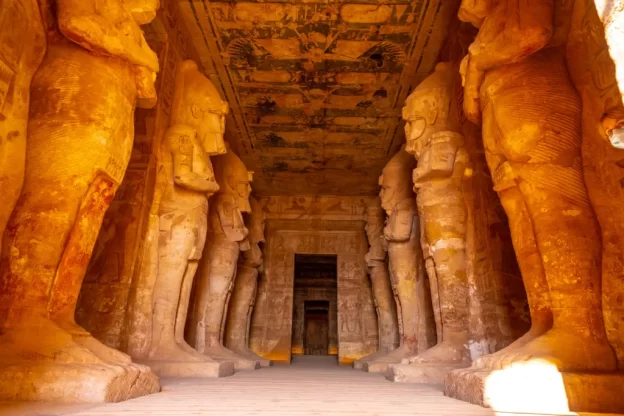
At Abu Simbel you will see Ramses ll’s temple, which is dedicated to gods Ptah, Ra-Horakhty, Amun, and the deified Ramses ll. It not only features his reverence for the deities like MA’AT, but historical accounts of his own life. Ramses ll was a part of the 19th Dynasty, which emerged from military leadership. This reality is reflected in the iconography of this great temple. The beauty and exceptional craftsmanship are striking. Adjacent to Ramses ll’s temple is a temple to his great wife Nefertari who was from the region that is today Sudan. Her temple is dedicated to the goddess Het-Heru, who is often referred to by the Greek name Hathor. The temple is also astonishing in its beauty. It has important political significance as this marriage brought peace between two political entities. If you view these two temples with a good guide, you will have an excellent feel for the world of Ramses ll and Nefertari, and the spirit of the times in which they ruled.

The Egyptian Museum is a must-see for anyone that visits Egypt to explore Kemetic History. The museum was first opened in 1902 and has faced a number of challenges ranging from theft to corruption. It has over 120,000 artifacts that range from the Pre-Historic era to the Late Period. What makes this museum special is not the number of artifacts, but the particular artifacts that you can see. There of several pieces from the rulership of Akhenaton. The Papyrus of Merer is an account of the process of transporting stone from the Sinai Peninsula to build Khafra’s pyramid. There is a small statue of Khufu, which is quite rare amongst all of the remaining artifacts from Kemet. I believe the most important artifact is the Narmer Palette, which is amongst the world’s oldest historical documents. This cosmetic palette is an indicator that it was Narmer that united the two lands. Through its symbology, it offers great insight into the priorities and culture of Kemet in the earliest era of unification of the two lands. The Grand Egyptian Museum and the National Museum can be interesting, however neither come close to the Egyptian Museum in regard to the range and significance of artifacts.

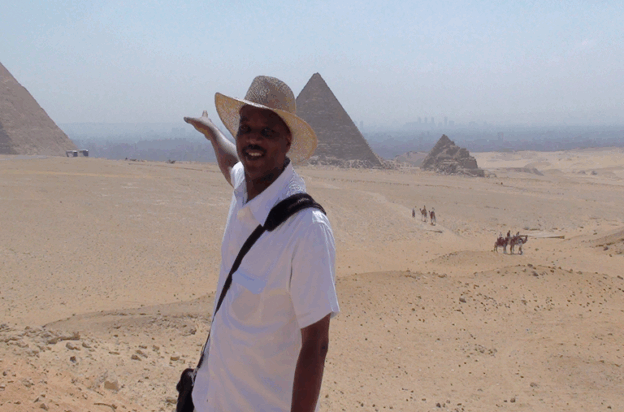
Of all the historical sites of Egypt, the most important and awe-inspiring is the Giza Plateau which the ancients referred to as “Kher Neter”. Egyptologist translate this as “the necropolis”. A necropolis is the land of the dead, like a cemetery for example. In the minds of the ancients, this would translate more like “The land of the reborn”. The 3 large pyramids are attributed to kings Khufu, Khafra, and Menkara of the 4th Dynasty. They are father, son, and grandson. Khufu’s pyramids stood 481 feet high/146.5 meters at one time. In the 1st century BCE a Greek scholar named Diodorus Siculus referred to Khufu’s pyramid as one of the 7 great wonders of the ancient world. Today it is the only one still standing, despite desecration over the hundreds of years. Each of the 3 major pyramids are unique in their own right. They represent a major step in the evolution of pyramid-building from the step pyramid of Djoser that was designed by Imhotep in the 3rd Dynasty.
The Giza Plateau also includes Her Em Akhet, which translates as “Heru on the Horizon”. It is known today as the Sphinx. There is lots of conjecture regarding the origins and meaning of this large and mysterious monolith.
There are many important structures on the Giza Plateau that are impressive but overlooked. For example, the satellite pyramids of Khufu’s and Menkhara’s pyramids. One of the satellite pyramids is attributed to Khufu’s mother Hetepheres, who was hugely influential. The tomb of Mersankh in the eastern cemetery of the Giza Plateau is intact, with hieroglyphs to aid her transition to the next realm. The western cemetery, just west of Khufu’s pyramid, has a pyramid that is attributed to Hemiunu, who is acknowledged as the primary designer of the Giza Plateau.
No one knows what the future holds. These sites have been under threat of destruction for over 1500 years. To this day, many are offended by their presence. Delve into the world of ancient Kemet while you still can. If you would like to experience a trip of a lifetime, join an educational tour that will be led by Perry Kyles, PhD. If you would like a guided tour of the Giza Plateau only, click here for a wonderful guide that will educate you and protect you from the unsavory elements in Egypt.
