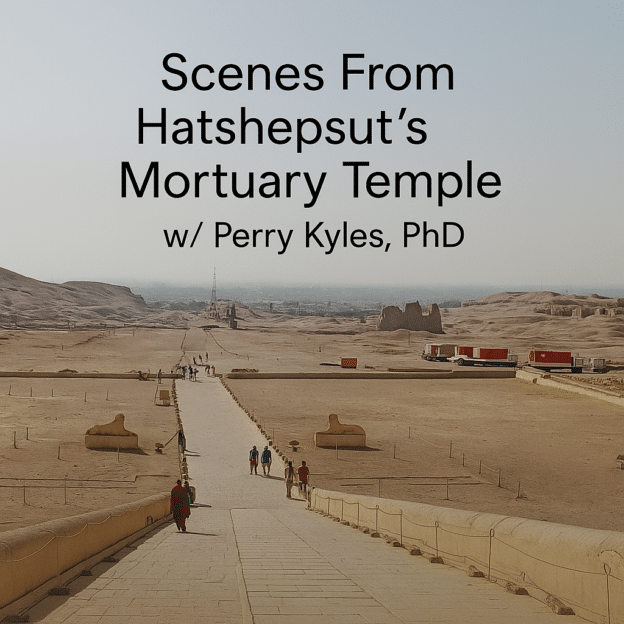
Scenes From Hatshepsut’s Temple In Deir el-Bahari In Luxor, Egypt
Hatshepsut didn’t just build a temple — she carved an idea into the cliffs of Luxor. She rose to the throne of Kemet and declared her divine right to rule. This sacred terrace is her stage, her sanctuary, and her architectural masterpiece.
In this video, you’ll step inside her world with me. This isn’t just a tour clip — it’s a window into the mind of one of the greatest leaders to ever shape human history. Press play and feel the power of Hatshepsut for yourself.
BLACKS & CHRISTIANS MAINTAINED THE LEGACY OF KEMET
In the last decade, a new confidence has swept through some circles in modern Misr. You hear it online, in the streets, in the cafés, and especially in the comment sections: “We are the Pharaohs. We built the pyramids. Kemet is ours.” These declarations come with an air of certainty so intense that anyone who questions them is treated as an enemy, especially if that person is a Black descendant of the African civilizations that shaped the Nile Valley long before Arabic even existed.
But let us speak plainly: this is a retroactive claim, not a historical one. It is a nationalistic costume worn today, not a cultural inheritance preserved over the centuries. And the historical record — the actual documented behavior of the rulers and populations of Misr for over a thousand years — exposes the truth with clarity.
For most of their history under Arab rule, the people now claiming Kemet did not love it, did not protect it, and did not identify with it. The ancient temples, pyramids, statues, and sacred spaces that the world reveres today were, for centuries, treated not as cultural treasures but as pagan remains. The modern claims only became loud once Kemet became profitable — once tourists, scholars, and the global imagination elevated these relics to world significance.
To understand how deep the disconnect truly is, consider the most striking example: Al-Aziz Uthman, the son of Salah al-Din. In the 1190s, he ordered his men to destroy the pyramids, beginning with the Pyramid of Menkaure. This was not an accident. It was not neglect. It was a deliberate attempt to erase the civilization that many in Misr today suddenly insist they descend from. His workers tried for months, chiseling away at casing stones that ancient Africans had engineered far beyond the abilities of their medieval attackers. They failed, but the scars they left on the pyramid remain as a permanent record of their contempt.
This episode is not an isolated moment of fanaticism. It reflects exactly how ancient Egypt was viewed by the rulers of Misr for centuries. Pyramids were seen as monuments of disbelief. Temples were considered places of sorcery. Hieroglyphs were believed to be magical spells. The ancient Egyptian language was allowed to die without a single institution stepping forward to preserve it. The culture that modern Egypt markets to the world existed, for most of Arab Egypt’s history, in the shadows — unloved, unclaimed, and undefended.
And while this neglect was unfolding in Misr, there were three groups who kept the flame of Kemet alive.
First, the Coptic Egyptians, whose language is the last surviving form of ancient Egyptian, preserved in their church liturgy long after official institutions abandoned it. The Copts carried linguistic DNA that links directly back to the temple walls.
Second, the Nubians, whose kingdoms continued building pyramids and honoring Nile valley traditions long after Egypt had turned away from its own past. In many ways, Nubia preserved the spirit of Kemet more faithfully than Cairo did for centuries.
Third — and perhaps most ironically — Black people across the African diaspora, especially in the United States and the Caribbean, defended Kemet’s African identity when almost no one else cared. Frederick Douglass, Martin Delany, and later generations of Afrocentric scholars honored and studied Kemet at a time when many Egyptians were still afraid to walk inside a temple at night.
So when certain voices in modern Misr declare an intellectual war on Black people for acknowledging the African roots of Kemet, they are waging war on historical truth. They are attacking the very communities that preserved the memory they now attempt to monopolize. And they are claiming a heritage their own ancestors tried to bury, tear down, or ignore.
Modern Egyptians have every right to take pride in the monuments that stand on their soil. Pride is human. Nationalism is powerful. But pride does not rewrite history. Geography does not equal lineage. And shouting does not create a connection where centuries of cultural rejection left a void.
Kemet was never “lost.”
It was ignored — until the world reminded Misr what stood in its own backyard.
The people who now try to silence Black voices speaking on Kemet have inherited a land, not a tradition. Yet they direct their hostility not toward the erasure committed by medieval rulers, not toward the colonial powers who stole monuments and mummies, but toward the very descendants of the African world that gave Kemet birth.
If they insist on intellectual war, then the battlefield will be history itself — and history is not on their side
This presentation was inspired by the Sudanese people that I met while in Egypt. They know they that are the true descendants of the pharaohs, however the modern Egyptians are darn near ready to fight when the truth of Kemet’s African origins is mentioned. I’ll address their reasons for this is another presentation. Today, I’ll make it clear that the pharaonic culture came into Egypt from the place that the Arabs named Sudan, which in Arabic means “Land of the Blacks”. You might also want to see my video called “Ethiopia and The Gift of the Nile”. I’ll put the link in the description box.
There are a few important details that it would benefit you to know. Firstly, the Africans of Sudan fought off the Romans that ruled Egypt after the Greeks. Also, Sudan fought off the Arab hordes until the early 16th century – nearly 1000 years after Egypt gave way to the Arabs.
The second detail of extreme importance is that there is a hugely significant difference between the borders of Ancient Kemet with Ancient Nubia, and the border of modern Egypt with modern Sudan. Borders in Antiquity were not as rigid as they are today. Throughout most of Ancient History the border between these two lands was the 1st Cataract. In 1899 Arabic Egypt, along with their British overlords, moved the border 168 miles/270 kilometers south into Sudan. Consequently, land that had been Sudanic became modern Egyptian. From their the Arabs and their overlords shamelessly began to revise history.
THE EVIDENCE FROM QUSTUL
Qustul was an archeological site that was in Sudan before the border was moved in 1899. It is now within the border of modern Egypt. The early civilizations of Qustul had a great cultural influence on Kemet. One of these influences is the concept of divine kingship, which means that the Pharaoh was thought of as a divine representative of God – he is “Heru on Earth”. Kemet was an elaboration of the political entities that emerged in the lands south of the Ancient border like Qustul – not a culture that emerged from the Asia.
The representation of the king as a hawk also has a Nubian origin and the best evidence for this was found in a cemetery in Nubia in 1964 by Keith Seele. This cemetery is underwater today because of the building of the High Aswan Dam that was finished in 1970, however the evidence supports the conclusion of an “up south” origin of Kemetic civilization and Pharaonic rule. An incense burner was found at Qustul that has several images that provide insight into the world of Pharaonic culture. It is generally accepted that the incense burner is about 800 years older than the accepted date of 3100 BC, which is commonly accepted as the date that the two lands of Kemet were united. From the left to the right, the incense burner possesses images of a serekh, which is a symbol for kingship that was later borrowed by Kemites. You can also see a bound captive. Next a man is wearing the crown that would later be used as the crown of Upper Egypt. The beard is apparent and so is a flail. Just in front of him is a hawk standing atop a castle is a symbol of kingship. If you are ever in Chicago, Illinois in the United States you should see the Qustul incense burner for yourself at the Oriental Institute Museum.
THE GEBEL SHEIKH SULEIMAN RELIEF
There are other pieces of evidence that suggests a movement of pharaonic culture down the Nile from modern Sudan to what is today called Egypt. The Gebel Sheikh Suleiman relief that was found in Sudan about 49 kilometers/30 miles south of Qustul is one of the Sudanic monuments that provides valuable information. On the monument, from the left to the right, there is a hawk atop a castle, a bound captive who is bound with the symbol for Ta Seti “Land of the Bow”, and also there appears to be two birds atop what became the hieroglyphic determinative for “city” or “state”. The art features slain enemies, just as it would hundreds of years later in Kemet.
THE BULL PALATTE
Some of the same iconography is featured on the Bull Palette, like the serekh and the hawk. There appears to have been competition for rulership between centralized states throughout the region. These competing states appear to have used the same iconography for kingship, like the hawk and the bull. This indicates that there was an extremely long cultural history that emerged throughout the region, long before the artifacts that we have found. A clear example of this is the similarities between the Bull Palette, which is currently housed at the Louvre Museum in Paris, France and the Narmer Palette, which you will see when you visit the Cairo Museum in Cairo, Egypt. Both of these artifacts are thought to have been used as palettes to mix makeup.
The Bull Palette is thought to have been created in the centuries leading up to the 1st Dynasty, which began when Pharaoh Narmer united “The Two Lands”. The obverse side of the palette features a fortified city or state with a lion and a vessel, or vase, inside. I surmise that this indicates an area that is protected by a monarch, and also the presence of a settled community. On the front side at the bottom appears to be a fortified city with a bird within it. It is difficult to determine since the palette has been broken and the whole of it cannot be pieced together. Near the top on this side of the palette is a vivid image of a bull killing a man. This symbolizes a king destroying his enemies.
The reverse side depicts this same scene of the bull vanquishing his enemy. The only difference is that the head of the enemy can be seen. This appears to be a foreigner from outside Africa, as indicated by the enemy’s hair. The vanquished man has hair quite similar to the Asiatic captives featured at the entrance of Ramses ll temple at Abu Simbel. This same enemy is depicted towards the bottom in a vulnerable position. Towards the center of the reverse side there are five images all of which are connected to a rope by an arm and fist. The first two are two hippopotami, the third is an ibis bird, which was anthropomorphized as the deity Djehuty, who is most often referred to by the Greek variant Thoth. The fourth is the Heru/Horus falcon, and the fifth is thought to be a symbol for the deity Min. The Bull Palette was found at Nekhen, which is currently known by its Greek name Hierakonpolis.
THE NARMER PALETTE
The Narmer Palette was found in the same city as the Bull Palette; however, it relates to a time after the Bull Palette. On both sides of the Narmer Palette, towards the bottom, there is a bull ravaging his enemies. It is apparent that these men are the same enemies that are towards the bottom of the Bull Palette. There is a serekh at the top of both sides in the center. In this serekh is the hieroglyphic spelling of the name “Narmer”, with the catfish making the sound “nar” and the chisel making the sound “mer”. The center of the palette depicts a dramatic scene of Narmer holding an enemy by the hair with his left hand, while holding up a mace with his right hand. Here he is wearing the “hedjet”, which is the bulb-like white crown of Upper Kemet. On this side, there is also a picture of a hawk holding a tool that is forced into the nose of an enemy. This enemy is thought to be from a marshland, perhaps near the mouth of the Hapi, where it flows into the Mediterranean. On the reverse side of the palette, Narmer is presented with the “deshret”, which is the red crown of Lower Kemet. Before him are four standard bearers with an animal skin, a canine, and two hawks. Once again, there is a serekh with a hawk on it. What follows next is a slew of dead bodies, presented in a way that signifies bodies slain in war. You must see this palette for yourself at the Cairo Museum!
The artifacts reveal that even though there may have been rival kings that were competing for dominance, the hieroglyphs and concepts that were associated with Kemet existed long before Kemet came into existence – long before Narmer united the two lands. If you look just beyond the smoke screen that was created by western and Arabic Egyptologists it becomes apparent that the Nubians of Ta Seti and Sudan are the true descendants of Kemet. The absurd claim of a mixed-race oasis emerging out of nowhere in Africa is only anti-black propaganda.
What if everything you thought you knew about African history was just the tip of the pyramid?
When we celebrate Black History, we often start with struggle. But the truth is, Black history begins with greatness—with a civilization so advanced that it became the foundation for countless cultures across Africa and the world.
That civilization is Kemet—the land the Greeks later renamed Egypt.
The Origin Story: Before the World Took Notice
Long before Europe’s rise or even the idea of the West, there was Kemet—the “Black Land.” It was not only a nation of pyramids and pharaohs, but a living university of astronomy, medicine, art, engineering, spirituality, and law.
This was not a civilization in isolation. Its influence radiated like the sun across the African continent. Through migration, trade, and spiritual exchange, Kemet seeded timeless traditions into neighboring kingdoms, especially Nubia, Kush, Axum, and even as far west as Ghana and Mali.
Kemet wasn’t just Africa’s past. It was—and still is—Africa’s backbone.
The Spiritual Blueprint of the Continent
The spiritual systems of Africa didn’t emerge randomly. Many of them reflect the sacred principles first recorded on the walls of Kemet’s temples.
Take Ma’at, the Kemetic concept of balance, truth, and cosmic order. You’ll find echoes of Ma’at in the moral teachings of the Yoruba, the cosmology of the Dogon, and the ancestral reverence of the Akan. Kemet taught that the soul’s purpose was to live in alignment with the divine—a truth still honored today in African spiritual practices across the globe.
The afterlife beliefs, use of sacred symbols, ritual storytelling, even the wearing of certain colors and regalia—many of these stem from Kemet’s spiritual science.
Language, Leadership & Legacy
The concept of divine leadership—where the ruler is both political and spiritual—didn’t die with the Pharaohs. It migrated. The idea of sacred kingship appears in ancient Ethiopia, among the Ashanti of Ghana, and in royal systems from the Congo to the Zulu Kingdom.
African languages, too, carry the linguistic fingerprints of Kemet. From shared word roots to cosmological terms, Kemet’s intellectual legacy is quietly embedded in the very languages people speak to this day.
And the art? From West African masks to Nubian jewelry, the influence of Kemetic aesthetics is undeniable. The symbolism, symmetry, and spiritual purpose in African art all echo Kemet’s visual language.
Why This Connection Matters More Than Ever
The erasure of Kemet’s African roots wasn’t accidental. For centuries, the idea that Africans could have built such a brilliant civilization was downplayed—or outright stolen.
But the truth is rising. Rediscovering Kemet isn’t just an academic pursuit—it’s a reclamation of identity.
Understanding this connection transforms the way we see Africa—and ourselves. It tells our children that their history doesn’t begin in chains. It begins in crowns, temples, and stars.
Step Into the Story: The Kemet 101 Tour
Want to do more than just read about this history? Walk it. Touch it. Feel it.
Join us on the Kemet 101 Educational Tour to Egypt with Dr. Perry Kyles—a 12-day journey through ancient temples, sacred tombs, and living history. This isn’t a vacation. It’s a spiritual return. It’s your personal reconnection with the roots of Black brilliance.
🛕 Experience the real Kemet. Feel the truth for yourself.
Walk into most schools today and you’ll likely hear that civilization began in places like Mesopotamia or Greece. You’re taught that science, mathematics, medicine, and philosophy were European contributions. But if you’ve been studying African Origins seriously, you know that narrative doesn’t hold up.
The truth is, long before Greece, long before Rome, long before the so-called “cradles of civilization,” there was Kemet.
Kemet is the name that the ancients used to describe their land. It means “The Black Land.” Now, some say this referred to the fertile soil of the Nile Valley. But those of us who have studied the people, the culture, and the legacy of Kemet know it was also a reference to the people themselves. They were Black. They were African. And they were brilliant.
This is the story they don’t teach you in school. But it’s written in stone.
The Foundation of the Sciences
If you’ve ever stood before the Great Pyramid, you understand this wasn’t built by guesswork or superstition. The builders of Kemet understood geometry, engineering, astronomy, and logistics. Every stone was placed with intent. The alignment of temples and pyramids with the stars is not coincidental. It reflects a scientific understanding that predates the Greek world by thousands of years.
We are often told that Pythagoras “discovered” the 3-4-5 triangle. But that formula was being used by builders in Kemet long before Pythagoras was born. The proof is in the architecture.
When you study Imhotep, you find a man who was both a healer and an architect. He designed the Step Pyramid of Djoser, and he wrote medical treatises that include surgical techniques and plant-based remedies. Imhotep lived nearly 2,000 years before Hippocrates. Yet one is called “the father of medicine” while the other is nearly forgotten outside of African-centered study.
Black African People Built Kemet
Let me be clear. The people who built Kemet were Black Africans.
This is not just my opinion. This is not some fringe theory. This is supported by the physical evidence — the statues, the paintings, the hairstyles, the medu netcher (hieroglyphs), and the geographical flow of culture from the south to the north.
Kemet did not rise from the Mediterranean. It rose from Nubia, from the heart of Africa, and it moved north along the Nile. In fact, when you visit Aswan and Elephantine Island, and you speak with Nubian scholars, you begin to understand that the south is the root of it all.
But over time, the image of these people changed. Not because the truth changed, but because of colonial influence.
The Whitewashing of African History
Colonial scholars had a problem. If the world knew that Africa birthed civilization, it would destroy the myth of African inferiority. So they rewrote history.
They removed noses from statues. They repainted images with lighter skin. They labeled spiritual systems as “mythology” while embracing the borrowed fragments in European systems as divine truth.
Museums across the Western world are filled with artifacts from Kemet, but the interpretation is filtered through a colonial lens. The names are changed. The people are lightened. The story is stripped of its African context.
This was no accident. It was strategic.
What We Must Do Now for Our African Origins
We can’t wait for school systems to catch up. We must teach ourselves. We must teach our children. We must study the texts, walk the land, and listen to the voices of our ancestors.
Kemet wasn’t a mystery. It wasn’t a myth. It was a thriving African civilization that shaped the world. And it is our duty to reclaim it — not just for the sake of pride, but for the sake of truth.
If you want to understand modern civilization, you need to understand Kemet. If you want to understand yourself, your lineage, and your purpose, you need to understand the values that guided our ancestors — values like Ma’at, which stood for balance, truth, justice, and reciprocity.
Those values built Kemet. And they can still build us today.
Join the journey. Reclaim the legacy. The truth is written in stone.
The historical sites of Egypt are among the most visited in the world. Travelers visit the historical sites of Egypt to see the remnants of the ancient civilization whose citizens referred to it as Kemet. There are hundreds of historical sites, museums, and monuments in Egypt that relate to Kemet. Very few travelers have decades to give serious attention to each of them. To maximize your understanding and to make your experience memorable, I will give 5 sites that I believe are essential to exploring the world of Kemet during your visit to the Arab Republic of Egypt. Honorable mention goes to Hatshepsut’s great temple “Djeser Djeseru”, or “the Most Select and Holiest of Places”, at Deihr el-Bahri.
5. Karnak Temple
Karnak is perhaps the largest temple in the world. The ancients referred to it as “Ipet-isut”, which means “The Most Select of Places”. It may have been in existence during the Old Kingdom but became more relevant during the Middle Kingdom. Spirituality was an important part of Kemetic life for royalty, priests, scribes, and every day folk. The temple, its features, and its inscriptions give a window into Kemetic spiritual life. The rise of this impactful temple was contemporaneous with the rise of the almighty god Amen. Amen had a wife/compliment named Mut and a son named Khonsu, both of which have temples attributed to them at the Karnak Temple. Karnak is THE spiritual center of a spiritual center.
4. Temple of Seti
The temple of Seti l at Abydos is extremely important, yet overlooked by tourists. If you travel to Egypt to educate yourself about the ancients, or to explore the life and culture of Kemet, I think you MUST see the King’s List at Abydos. The King’s list is one of the most important sites, and historical documents that is still intact, although it has experienced some damage. Proper socialization and knowledge of the ancestors was an important part of preparing Kemetic kings to be successful. This King’s List features Seti l teaching his son Ramses ll about the great kings of Kemet. Ramses ll is featured with a child with the side-lock of hair. This list is one of the resources that reveals the sequence of kings. The temple is about a 3 drive from Luxor, but it is well worth it for educational purposes.
3. Abu Simbel
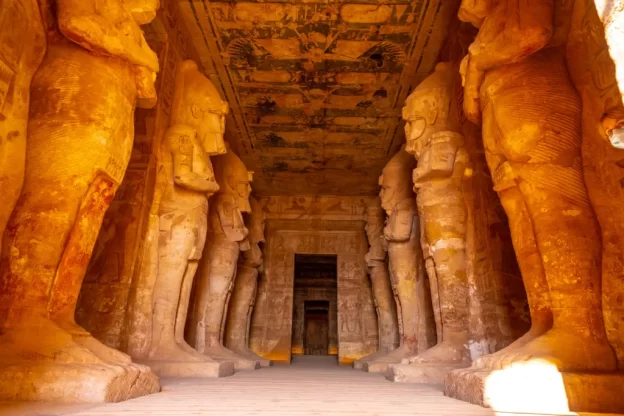
At Abu Simbel you will see Ramses ll’s temple, which is dedicated to gods Ptah, Ra-Horakhty, Amun, and the deified Ramses ll. It not only features his reverence for the deities like MA’AT, but historical accounts of his own life. Ramses ll was a part of the 19th Dynasty, which emerged from military leadership. This reality is reflected in the iconography of this great temple. The beauty and exceptional craftsmanship are striking. Adjacent to Ramses ll’s temple is a temple to his great wife Nefertari who was from the region that is today Sudan. Her temple is dedicated to the goddess Het-Heru, who is often referred to by the Greek name Hathor. The temple is also astonishing in its beauty. It has important political significance as this marriage brought peace between two political entities. If you view these two temples with a good guide, you will have an excellent feel for the world of Ramses ll and Nefertari, and the spirit of the times in which they ruled.
2. The Museum of Egyptian Antiquities in Cairo
The Egyptian Museum is a must-see for anyone that visits Egypt to explore Kemetic History. The museum was first opened in 1902 and has faced a number of challenges ranging from theft to corruption. It has over 120,000 artifacts that range from the Pre-Historic era to the Late Period. What makes this museum special is not the number of artifacts, but the particular artifacts that you can see. There of several pieces from the rulership of Akhenaton. The Papyrus of Merer is an account of the process of transporting stone from the Sinai Peninsula to build Khafra’s pyramid. There is a small statue of Khufu, which is quite rare amongst all of the remaining artifacts from Kemet. I believe the most important artifact is the Narmer Palette, which is amongst the world’s oldest historical documents. This cosmetic palette is an indicator that it was Narmer that united the two lands. Through its symbology, it offers great insight into the priorities and culture of Kemet in the earliest era of unification of the two lands. The Grand Egyptian Museum and the National Museum can be interesting, however neither come close to the Egyptian Museum in regard to the range and significance of artifacts.
1. Giza Plateau
Of all the historical sites of Egypt, the most important and awe-inspiring is the Giza Plateau which the ancients referred to as “Kher Neter”. Egyptologist translate this as “the necropolis”. A necropolis is the land of the dead, like a cemetery for example. In the minds of the ancients, this would translate more like “The land of the reborn”. The 3 large pyramids are attributed to kings Khufu, Khafra, and Menkara of the 4th Dynasty. They are father, son, and grandson. Khufu’s pyramids stood 481 feet high/146.5 meters at one time. In the 1st century BCE a Greek scholar named Diodorus Siculus referred to Khufu’s pyramid as one of the 7 great wonders of the ancient world. Today it is the only one still standing, despite desecration over the hundreds of years. Each of the 3 major pyramids are unique in their own right. They represent a major step in the evolution of pyramid-building from the step pyramid of Djoser that was designed by Imhotep in the 3rd Dynasty.
The Giza Plateau also includes Her Em Akhet, which translates as “Heru on the Horizon”. It is known today as the Sphinx. There is lots of conjecture regarding the origins and meaning of this large and mysterious monolith.
There are many important structures on the Giza Plateau that are impressive but overlooked. For example, the satellite pyramids of Khufu’s and Menkhara’s pyramids. One of the satellite pyramids is attributed to Khufu’s mother Hetepheres, who was hugely influential. The tomb of Mersankh in the eastern cemetery of the Giza Plateau is intact, with hieroglyphs to aid her transition to the next realm. The western cemetery, just west of Khufu’s pyramid, has a pyramid that is attributed to Hemiunu, who is acknowledged as the primary designer of the Giza Plateau.
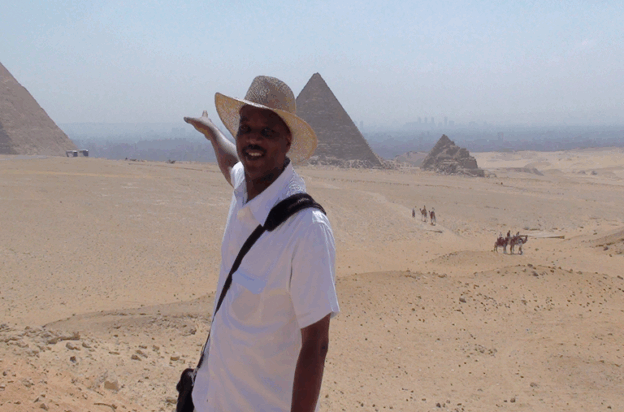
No one knows what the future holds. These sites have been under threat of destruction for over 1500 years. To this day, many are offended by their presence. Delve into the world of ancient Kemet while you still can. If you would like to experience a trip of a lifetime, join an educational tour that will be led by Perry Kyles, PhD. If you would like a guided tour of the Giza Plateau only, click here for a wonderful guide that will educate you and protect you from the unsavory elements in Egypt.
FREE SHIPPING ON ALL ORDERS
98% of our orders are shipped within 2 business days