Author Archives: Cullen Banks

Gold in Q3 2025: Record Highs, Market Volatility, and What’s Next

Gold in Q3 2025: Record Highs, Market Volatility, and What’s Next


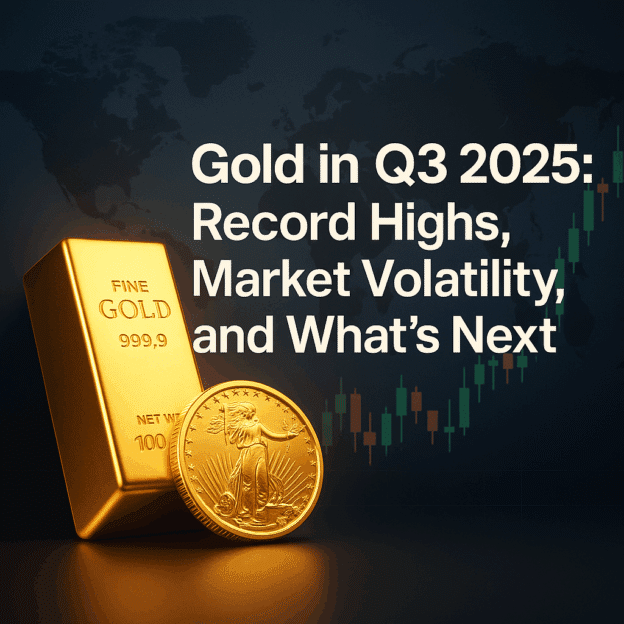
Gold in Q3 2025 has been a landmark period for gold investors. Prices reached record highs, global events sparked volatility, and shifting demand patterns are reshaping the market landscape. Whether you’re a seasoned investor or exploring gold for the first time, the developments this quarter hold important lessons for protecting and growing your wealth.


Gold in Q3 2025 a Record High: $3,534 per Ounce


In August 2025, gold reached a new all-time high of $3,534 per ounce, representing a 32% year-to-date increase. This rally was fueled by geopolitical tensions, persistent inflation concerns, and a brief market shock over potential tariffs on imported gold bars.

For context, just five years ago—in 2020—gold averaged around $1,770/oz. This means investors who held gold during this period have seen nearly 100% growth in asset value, far outpacing inflation and many stock market indexes.

The tariff scare came after a U.S. Customs ruling hinted at imposing up to 39% tariffs on 1-kg and 100-oz bars from Switzerland. While this initially triggered a price spike, the markets stabilized after President Trump confirmed, “Gold will not be Tariffed!” Still, the episode highlighted how political uncertainty can quickly influence market movements.


Volatility Fueled by Fed Policy and Data Surprises


While gold’s overall trajectory has been upward, the quarter also saw sharp swings. Prices rose on expectations of Federal Reserve interest rate cuts and a softer U.S. dollar, reaching $3,357.65/oz. However, hotter-than-expected U.S. inflation data tempered hopes of aggressive cuts, leading to a 1.5% weekly drop in mid-August.

This pattern underscores gold’s role as both a safe haven and a market-sensitive asset. In times of economic uncertainty, investors often flock to gold, but monetary policy shifts can cause short-term turbulence.


Gold in Q3 2025 Demand Dynamics: Who’s Buying and Who’s Pulling Back?


Central banks remain the largest consistent buyers of gold, with over 900 tonnes purchased globally by mid-2025. China alone accounted for 120 tonnes, solidifying its position as one of the world’s top gold accumulators.

However, consumer jewelry demand in China and India—traditionally the largest gold markets—has weakened due to high prices and softer economic conditions. At the same time, gold-backed ETFs saw strong inflows, with 397 tonnes added in the first half of 2025, the highest since 2020. This shift suggests that institutional and strategic investors are increasingly favoring gold as a financial asset over its traditional role in luxury markets.


Forward Outlook: Consolidation with Potential for Breakout of Gold in Q3 2025


Looking ahead, analysts at Citi forecast gold will likely consolidate between $3,100 and $3,500 through the remainder of Q3, with possible dips below $3,000 if global growth improves. However, if geopolitical tensions escalate or economic conditions deteriorate, prices could rise another 10–15%, potentially surpassing $3,800/oz.

This dual scenario means now is a crucial moment to evaluate your portfolio. Gold’s current levels may present both defensive and opportunistic buying opportunities.


Key Technical Levels to Watch


From a technical perspective, analysts identify $3,200 as strong support. If gold holds above this level, it suggests market confidence and buying strength. On the upside, breaking through the $3,450–$3,500 resistance range could open a path toward $3,800 and beyond.

For active traders, these thresholds offer important entry and exit points. For long-term holders, they serve as reassurance that gold’s trend remains fundamentally strong.


Real-World Takeaway


If you had invested $10,000 in gold at the start of 2023, when prices averaged around $1,900, your holdings would be worth roughly $18,589 today at the Q3 2025 peak. That’s an 85% gain in less than three years—without the volatility of the stock market or the eroding effects of inflation on cash savings.

Secure Your Wealth with Physical Gold

The Gold Marketplace offers a wide range of gold bars, coins, and bullion products sourced from trusted mints and refineries. These are not just collectibles—they’re globally recognized stores of value you can hold in your hand.

Shop our Gold Products Today and start building a portfolio that’s ready for whatever the markets bring next.

Explore the Benefits of a Gold IRA

Did you know you can hold physical gold in your retirement account? A Gold IRA allows you to diversify your savings and protect against inflation while enjoying the same tax advantages as a traditional IRA.

We’ve prepared a comprehensive guide to walk you through the process step-by-step.
Download Your Free Gold IRA Guide and learn how to safeguard your retirement.

Learn the Truth: Gold vs The Banking Cartel

Packed with research, historical examples, and actionable strategies, this book will change the way you think about money forever.
Get Your Copy of Gold vs The Banking Cartel and take control of your financial future.

Gold in Q3 2025: Record Highs, Market Volatility, and What’s Next

The China-America 90-Day Trade Agreement: What It Really Means for Your Money

The China-America 90-Day Trade Agreement: What It Really Means for Your Money


Global headlines lit up: “China-America reach 90-day trade agreement!”


Sounds promising, right? But here’s the real question:


What does it mean for your wallet, your savings, and your next smart move as an investor?


Let’s break it down in plain terms. At The Gold Marketplace, we believe in educating first, selling second. So we’re unpacking this new trade truce in a way that actually helps you understand how global politics affect your purchasing power and why moments like these are exactly when gold and silver shine the brightest.


What Is the China-America 90-Day Deal?


It’s not a peace treaty. It’s a pause.

For 90 days, the U.S. and China have agreed to stop escalating their tariff war and instead work toward resolving long-standing trade issues like tech disputes, export bans, and intellectual property fights. It’s a chance to “cool off” after years of tension.

But let’s be honest: 90 days is a blink in global economics. It’s not a fix. It’s a delay.


Why This Impacts You Even If You’re Not a Trader


You might think, “I don’t import or export. Why should I care?”


Here’s the truth: Global trade tensions hit you at the checkout line.


Tariffs = price hikes. From groceries to electronics, you pay more when imports get taxed.

Uncertainty = weaker dollar. When investors get nervous, the dollar often dips.

Policy shifts = market volatility. Stock portfolios and retirement accounts ride these waves.

And when the dollar weakens, guess what gets stronger?


Gold. Every time.


Will The China-America Deal Lower Inflation?


In the short term, maybe a little. But let’s be real:

Inflation isn’t just about trade. It’s about decades of money printing.

Food and housing prices? Still rising.

Your paycheck? Likely not keeping up.

This deal won’t reverse the damage. At best, it pauses the bleeding.


The Bigger Picture for Investors


Here’s what seasoned investors are watching right now:

  • Gold vs. the Dollar – If the dollar slips post-deal, gold demand rises.
  • Geopolitical risk – One wrong move in negotiations, and markets panic.
  • Central Bank moves – They may hold interest rates… or surprise us. Either way, precious metals are a hedge.
  • Supply chains – If trust breaks again, companies scramble, and prices skyrocket.

In short: This 90-day deal doesn’t reduce risk. It just reshuffles it.


Why Gold (Still) Wins


Gold doesn’t care about politics. It doesn’t need a president or a trade pact to back its value.
It’s been trusted for 5,000+ years as a store of wealth. And in times of uncertainty, that trust only grows.

Gold is:

  1. A hedge against inflation
  2. A discreet store of value
  3. Highly liquid and borderless


This 90-day deal is your reminder:
Don’t let your wealth sit vulnerable in a system that pivots every election cycle.


Trade deals come and go. Gold stays.


Use this 90-day window wisely! Do not just to follow the news, but to take action. Your future self will thank you.


Ready to act?


Explore our curated gold bars, silver coins, and investment-grade metals at The Gold Marketplace.


Because real money doesn’t lose value. It holds it.


Want a deeper look at how the banking system devalues your money AND how gold quietly protects it?

Download our FREE book:
Gold vs. The Banking Cartel – the must-read that breaks down everything your bank doesn’t want you to know.


The China-America 90-Day Trade Agreement: What It Really Means for Your Money

Long-Term Implications of Tariffs on the Global Economy

Long-Term Implications of Tariffs on the Global Economy


Over the past few months, global headlines have been dominated by tariff announcements and trade retaliation. But while immediate market responses often steal the spotlight, it’s the long-term consequences of these actions that investors must not ignore.

This blog dives into how prolonged trade tensions could fundamentally reshape economic strategies across the globe—and why gold remains a pillar of financial resilience amid the uncertainty.


Implications of Tariffs: A Shift in Global Economic Policies


Tariffs are not just taxes on imports; they are tools that reshape supply chains, alter alliances, and trigger global economic realignment. When countries raise barriers, they force others to look inward—or find alternative partners.

One clear example is the ongoing tariff rift between the U.S. and China. According to the Peterson Institute for International Economics, U.S. imports from China fell by nearly 25% between 2018 and 2023 due to prolonged tariffs. In turn, China increased trade with ASEAN nations and the EU.

As more nations adopt protectionist policies, global trade becomes less predictable. Multinational corporations are already responding:

Apple shifted part of its iPhone production to India.

Volkswagen opened new factories in Brazil and Eastern Europe to reduce dependence on Chinese parts.

The IMF forecasts global GDP to shrink by 0.4% annually by 2026 if tariff escalations continue.

These are not short-term shifts. These are structural changes that may define the next decade of global commerce.


Implications of Tariffs: Inflation That Doesn’t Go Away


Unlike short-term inflation caused by supply shocks, tariff-driven inflation has staying power. That’s because it often leads to permanent changes in how goods are produced and distributed.

Let’s consider agricultural goods:
When tariffs were imposed on Canadian fertilizer in 2023, U.S. farmers faced input cost increases of up to 15%. Even after global prices eased, the lack of a stable trade route meant those elevated costs persisted into the 2024 planting season.

This pattern is now repeating across other industries:

Automotive parts tariffs raised repair and insurance costs for American drivers by 6.1% in 2024.

A Bank of America study projects that if trade barriers continue, U.S. consumer prices could stay 8–10% higher over the next five years compared to a no-tariff scenario.

In essence, once inflation embeds itself into the system due to tariffs, it doesn’t quietly leave.


Implications of Tariffs: Investor Behavior Is Evolving


As global uncertainty becomes the norm, investor behavior is changing. More people are looking beyond traditional assets and into alternatives that offer stability and hedge against global risk.

And no asset does that better than gold.

According to the World Gold Council, investment demand for gold surged 21% in 2023, not because of recession fears alone—but because of persistent geopolitical and trade instability. The long view is clear: gold doesn’t just react—it endures.

In 2025, amid renewed tariff talks and currency volatility, gold has already reached $3,127 per ounce, up from $2,265 the year prior. This is not just a commodity rising—it’s a reflection of deep systemic mistrust in paper assets and policy consistency.


Own What the World Trusts: Gold


If you believe the world is entering a new era of economic complexity, then it’s time to build protection into your financial future. At The Gold Marketplace, we provide authentic gold bars, coins, and bullion to help investors hedge against long-term global risk.

🔐 Explore Our Collection Now


Global uncertainty doesn’t pause for retirement planning. That’s why a Gold IRA is more relevant than ever. By converting part of your retirement savings into physical gold, you reduce your dependence on dollar-based assets—and gain peace of mind.

📥 Download Our Free Gold IRA Guide


In our eye-opening book, Gold vs The Banking Cartel, Dr. Perry Kyles lays out how modern banking systems manipulate currency and how long-term financial traps are hidden behind “official policy.”

📚 Get Your Copy Today


Final Thoughts


Tariffs are not just a headline. They are long-term signals that the world economy is entering a new phase—one marked by protectionism, inflation, and global realignment.

Gold is not a reactionary move. It’s a forward-thinking strategy.

As trade policies evolve and the global economy reshapes, one truth remains: those who prepare early are rarely the ones who suffer later.

Long-Term Implications of Tariffs on the Global Economy

Tariffs and Inflation: Connecting the Dots

Tariffs and Inflation: Connecting the Dots


When the government imposes tariffs, the public often hears buzzwords like “economic strength,” “manufacturing revival,” or “leveling the playing field.” But behind the political theater, tariffs have a real and often underappreciated consequence: inflation.

In this blog, we’ll examine exactly how tariffs fuel price increases, why this matters to every consumer and investor, and what financial leaders—like Federal Reserve Chair Jerome Powell—are saying about it. Most importantly, we’ll discuss how gold offers a buffer in this increasingly unstable environment.


How Do Tariffs and Inflation Work?


To put it simply, tariffs are taxes on imported goods. While they are imposed on foreign sellers, the cost rarely stops there. Importers pass these costs onto retailers, who in turn raise prices for consumers.

But it doesn’t stop with just one product. Tariffs often affect entire supply chains. For example, if the price of microchips from Asia rises due to tariffs, so does the price of everything that uses them—phones, computers, even cars.

Consider this:

After a round of U.S. tariffs in 2022 on semiconductor components, consumer electronics prices rose 6.8% year-over-year.

The Federal Reserve Bank of San Francisco estimated that tariff-related price increases contributed to roughly 0.3 to 0.5 percentage points of core inflation between 2018 and 2020.

In the words of Fed Chair Jerome Powell, during a 2024 congressional hearing:

“While tariffs can serve strategic interests, they add to inflationary pressures and complicate our mandate of price stability.”


The Domino Effect that Tariffs and Inflation Brings on the Economy


Tariff-induced inflation doesn’t only impact retail prices—it spreads across housing, food, transportation, and even interest rates. Here’s how the dominoes fall:

  1. Tariffs increase production costs.
  2. Companies raise prices to protect profit margins.
  3. Consumers pay more for everyday goods.
  4. The Federal Reserve raises interest rates to fight inflation.
  5. Higher rates slow borrowing, investment, and eventually, job growth.

It becomes a dangerous cycle. Inflation goes up, economic activity slows, and yet the cost of living keeps rising. This is what economists call stagflation—slow growth and rising prices at the same time.


Tariffs and Inflation: A Quiet Crisis in Disguise


What’s alarming is that inflation can build quietly in the background, even before it shows up in headlines. Tariffs often hit essential goods first—materials, energy, industrial parts. These increases take time to trickle down to the end consumer.

So while inflation may seem “moderate” now at around 3.4% as of March 2025, many analysts believe the underlying pressures are far greater, especially with fresh tariffs on the horizon. If left unchecked, we could be looking at 5–6% inflation within the year, especially in sectors like construction, automotive, and energy.


Why Gold Makes More Sense Than Ever


In this environment, gold isn’t just a traditional asset—it’s a strategic defense tool. While fiat currencies weaken under inflationary strain, gold retains its purchasing power. Historically, when inflation rises, gold prices follow.

In 1979, during a period of 11% inflation, gold jumped 120% in a single year.

In 2020–2022, as inflation began surging post-COVID, gold rose from $1,470 to over $2,050 per ounce.

And now, as we face the uncertainty of tariff-fueled inflation, gold is once again proving its worth. Since January 2025, gold has already increased by over 11%, while equities have shown mixed returns.


Don’t wait until inflation eats away at your savings. Start diversifying today with physical gold bars, coins, and bullion from The Gold Marketplace.

👉 Explore Our Premium Gold Products


With interest rates rising and inflation looming, retirement accounts based on stocks and bonds are increasingly vulnerable. But there’s a solution: a Gold IRA, backed by tangible, inflation-resistant metal.

📥 Download Our Free Gold IRA Guide


It’s time to learn what they won’t teach you in school. In our bestselling book, Gold vs The Banking Cartel, Dr. Perry Kyles exposes the flawed logic of the fiat monetary system and the long-term dangers of unchecked inflation.

📚 Grab Your Copy Now


Final Thoughts


Tariffs may seem like a political maneuver—but their economic ripple effects are very real. From the supply chain to your shopping cart, they drive up prices and put pressure on central banks. Inflation is not just a risk—it’s already unfolding.

The smart move is not to panic, but to prepare.

Gold gives you that preparation. It gives you peace of mind. It gives you control.

Tariffs and Inflation: Connecting the Dots

Understanding the New U.S Tariffs and Their Immediate Impact

Understanding the New U.S Tariffs and Their Immediate Impact


In recent weeks, the U.S. has reignited global trade tensions with a bold move: sweeping new tariffs targeting key imports. These changes are already shaking financial markets and raising fears of inflation. But what does this really mean for the everyday American—and how can gold help you weather the potential storm?

Let’s break it down.


What Are These New U.S Tariffs About?


On March 31, 2025, the U.S. government announced tariffs on $60 billion worth of imported goods, including steel, aluminum, electric vehicles, and key manufacturing components. The move is aimed at reducing dependence on foreign production and reshoring American industry. However, it has sparked swift retaliation from trade partners like China and the European Union.

While national security and economic independence are often cited as justifications, there are real-world consequences to consider.


How Do U.S Tariffs Affect You?


Tariffs function like a tax on imports. When companies pay more to bring goods into the U.S., those costs often get passed on to consumers. For example:

The 2018 steel and aluminum tariffs raised prices by an estimated 20–25% across multiple industries—from cars to construction.

After those tariffs, U.S. manufacturing costs increased by nearly $900 per household, according to the Tax Foundation.

This time, economists at JPMorgan warn that these new tariffs could lead to an overall inflation rise of 0.4% by mid-2025. That might seem small—but in an economy where inflation is already creeping above the Fed’s 2% target, it matters.


Market Reactions and Volatility


Markets hate uncertainty. Since the announcement:

The S&P 500 dropped by over 2.6% in just 48 hours.

Tech-heavy indexes like the Nasdaq plunged 3.1%, fueled by concerns over rising costs and slowing demand.

Meanwhile, gold surged to $3,127 per ounce—breaking records.

Why gold? That leads us to an important point.


Gold: The Historical Hedge Against Turmoil


Historically, gold has thrived during times of geopolitical tension, inflation, and market instability. It is:

Uncorrelated with the stock market, meaning it often moves in the opposite direction.

Tangible and finite, unlike printed currency, making it resistant to manipulation or devaluation.

Highly liquid, so you can sell it anytime, almost anywhere in the world.

When central banks face uncertainty, they don’t buy stocks—they buy gold. In fact, central bank gold purchases hit a record 1,136 tonnes in 2023, according to the World Gold Council. That’s because gold is not just a commodity—it’s protection.


📢 Take Control: Start Your Gold Journey


In uncertain times, smart investors don’t wait—they prepare.

At The Gold Marketplace, we offer top-quality gold bars, coins, and bullion to help you diversify your portfolio and safeguard your wealth.

👉 Explore Our Gold Collection Now


Thinking long term? Consider a Gold IRA—a retirement account backed by physical gold instead of paper assets. It’s an excellent hedge against inflation and a smart way to preserve wealth for the future.

📘 Download Our Free Gold IRA Guide Here


Want to dive deeper into why gold outperforms fiat currency and why the current financial system is designed to fail you?

📚 Read our book: Gold vs The Banking Cartel

Final Thoughts


The U.S Tariffs battle is only beginning. As prices rise and markets react, the average investor must make a choice: ride the wave of uncertainty—or prepare with assets that have stood the test of time.

Gold has always been “God’s money”—and it may be your safest bet yet.

Stay tuned this week as we continue exploring:

  1. How U.S Tariffs trigger inflation
  2. The safe-haven power of gold
  3. Investment strategies in chaotic times

Understanding the New U.S Tariffs and Their Immediate Impact

Breaking Free—How to Protect Yourself from Banking Cartel Control

Breaking Free—How to Protect Yourself from Banking Cartel Control


For decades, the banking cartel control money, credit, and financial policies. The system is designed to keep people in debt, inflate their savings away, and limit their financial choices. But you don’t have to play their game.

In Episode 214 of The International Risk Podcast, Dr. Perry Kyles explains how to break free from banking cartel control. This module reveals why fiat currency is designed to fail, how gold, silver, and Bitcoin offer real alternatives, and what steps you can take to protect your wealth.


Why Fiat Currency Loses Value Over Time


The U.S. dollar was once backed by gold. But in 1971, the U.S. abandoned the gold standard, allowing the government to print unlimited money. Since then, the dollar has steadily lost its value.

📌 The truth about fiat currency:

  1. It is backed by nothing – The government can create as much as it wants.
  2. Inflation destroys purchasing power – The more money printed, the less each dollar is worth.
  3. Your savings lose value – The same money buys fewer goods over time.

📌 Example: The Dollar’s Decline Since 1971

In 1971, $1 could buy 4 gallons of gas. Today, it buys less than a third of a gallon.

A brand-new car in 1971 cost $3,500. Today, the average price is over $48,000.

Since the Federal Reserve was created in 1913, the dollar has lost over 96% of its value.

🔹 Fiat money is failing, but gold never loses value. Start investing in gold today.


Gold and Silver – The Ultimate Alternative to the Banking Cartel Control


Unlike fiat money, gold and silver have been trusted stores of value for thousands of years. They cannot be printed, manipulated, or controlled by banks.

📌 Why gold and silver protect wealth:

  1. Scarcity – Gold and silver exist in limited supply.
  2. Tangible assets – They are real, unlike digital numbers in a bank account.
  3. Hedge against inflation – As paper money declines, gold rises in value.

📌 Example: Gold’s Price During Financial Crises

In 2008, gold was $700 per ounce. By 2011, it hit $1,900 while stocks crashed.

In 2023, gold surpassed $2,000, proving its long-term stability.

🔹 Central banks print money, but they cannot print gold. Shop gold and silver now.


How Bitcoin and Cryptocurrencies Challenge Banking Cartel Control


Bitcoin was created in 2009 after the 2008 financial crisis. It was designed to offer financial freedom outside government control. Unlike fiat money, Bitcoin is decentralized, meaning no central bank can manipulate it.

📌 How Bitcoin is different from fiat currency:

  1. Limited Supply – Only 21 million Bitcoin will ever exist.
  2. No Middlemen – Transactions happen without banks.
  3. Global Access – No government can shut it down.

📌 Example: Bitcoin vs. the U.S. Dollar

In 2010, Bitcoin was worth $0.08 per coin.

In 2021, Bitcoin reached $69,000—an increase of over 86 million percent.

While fiat money loses value, Bitcoin and gold hold purchasing power over time.

🔹 Bitcoin is digital gold, but real gold has survived for centuries. Learn about gold investing here.


Practical Strategies to Safeguard Personal Wealth from Banking Cartel Control


The banking cartel wants people dependent on fiat money. But you can take steps to secure your financial future.


1. Move Wealth Into Hard Assets

Gold, silver, and Bitcoin are not controlled by central banks. They hold value even when fiat money collapses.

📌 Fact: In Venezuela (2016-2021), hyperinflation wiped out savings. Gold and Bitcoin became the only safe stores of wealth.

👉 Protect your wealth with gold now.


2. Open a Gold IRA

A Gold IRA allows you to store retirement savings in physical gold instead of unstable paper assets.

📌 Fact: The U.S. printed over $5 trillion during the pandemic, driving inflation to 9% in 2022. Gold held its value.

👉 Secure your retirement with a Gold IRA.


3. Diversify Away from Banks

Relying solely on bank accounts exposes your money to inflation and financial instability. Consider holding:

  1. Gold and silver – Tangible stores of value.
  2. Bitcoin and cryptocurrencies – Decentralized and borderless.
  3. Alternative assets – Real estate and commodities.

📌 Fact: In 2013, Cyprus banks froze accounts and took customer funds to cover government debt. Those with gold and Bitcoin were unaffected.

👉 Read “Gold vs. The Banking Cartel” to learn more.


Final Thoughts – Take Control of Your Financial Future


The banking cartel is designed to keep people in debt. Their fiat money system rewards banks while devaluing personal savings. But you have the power to escape.

📌 The key to financial freedom is:

  1. Owning assets that banks cannot manipulate.
  2. Holding wealth outside of traditional banking.
  3. Taking action before the next financial crisis.

Most people won’t act until it’s too late. Those who understand the system and move into real assets will survive the next collapse.

💡 What’s your next move? Start securing your wealth today.

Breaking Free—How to Protect Yourself from Banking Cartel Control

The Future of Global Finance: What Comes After the Banking Cartels? — Dr. Perry Kyles on The International Risk Podcast

The Future of Global Finance: What Comes After the Banking Cartels? — Dr. Perry Kyles on The International Risk Podcast


For over a century, banking cartels have controlled global finance. Central banks manipulate money supply, interest rates, and credit access. They protect big financial institutions, not everyday people. But this system is beginning to crack.

In Episode 214 of The International Risk Podcast, Dr. Perry Kyles discusses the future of finance. Will there be a shift away from central banks and fiat currencies? Can decentralized finance (DeFi) and blockchain technology create real financial independence?

This blog, Module 3, explores what comes next.


Will the Global Finance Move Away from Central Banks?


For decades, people believed central banks were necessary for economic stability. But recent crises prove otherwise. Inflation is rising, national debts are unsustainable, and faith in fiat currency is declining. Many are asking: Do we still need central banks?


Signs that confidence in central banking is fading:

  1. Hyperinflation in Venezuela (2016-2021) – The Venezuelan bolívar lost 99.9% of its value, forcing people to use gold and crypto.
  2. The 2008 Financial Crisis – The Federal Reserve bailed out banks while millions lost homes and jobs.
  3. The U.S. National Debt Surging Past $34 Trillion – More money printing is inevitable, causing further devaluation of the dollar.

📌 Fact: Since 1971, when the U.S. left the gold standard, the dollar has lost over 96% of its value.

🔹 Gold is outside the control of central banks. Start investing in gold today.


The Rise of Decentralized Finance (DeFi) and Blockchain Technology in Global Finance


Technology is creating alternatives to traditional banking. Decentralized finance (DeFi) allows people to store, lend, and trade assets without banks. Blockchain technology provides security and transparency.

Key benefits of DeFi:

  1. No Middlemen – No need for banks to approve transactions.
  2. Global Access – Anyone with an internet connection can participate.
  3. Lower Costs – No hidden banking fees or high-interest rates.

📌 Example: Bitcoin’s Rise as a Store of Value

In 2010, Bitcoin was worth $0.08 per coin.

By 2021, Bitcoin reached $69,000—growing over 86 million percent in value.

Unlike fiat money, Bitcoin is limited to 21 million coins, making it inflation-resistant.

🔹 Bitcoin is digital gold, but real gold has stood the test of time. Learn about gold investments here.


Can You Gain Economic Independence in a Rigged Global Finance System?


The banking cartel wants people to remain dependent on fiat money. But you don’t have to play their game. Here’s how to break free:


1. Move Wealth into Hard Assets

Fiat money loses value over time. Assets like gold, silver, and Bitcoin hold their worth.

📌 Fact: In 1971, $10,000 could buy a brand-new house. Today, it barely covers a few months of rent.

👉 Convert your savings into gold now.


2. Diversify Outside the Banking System

Banks limit access to money during financial crises. A Gold IRA keeps your assets in your control.

📌 Fact: In 2013, Cyprus banks froze customer accounts and took funds to cover government debt.

👉 Protect your retirement with a Gold IRA.


3. Support Financial Innovation

Decentralized finance is changing the way people store and transfer wealth. Learning about blockchain and digital assets can help secure financial freedom.

📌 Fact: Over $200 billion is now locked in DeFi applications—proving that people want alternatives to traditional banking.

👉 Read Dr. Perry Kyles’ book: “Gold vs. The Banking Cartel.”


Dr. Perry Kyles’ Final Thoughts on Reclaiming Financial Freedom


The banking cartel has controlled money for too long, but change is coming. As trust in central banks declines, people are turning to gold, crypto, and decentralized systems.

📌 The future of finance is about:

  1. Owning assets that banks cannot manipulate.
  2. Diversifying outside traditional banking.
  3. Staying educated on financial alternatives.

The next economic collapse will hit unprepared people the hardest. Those who understand money and act now will secure their wealth for the future.

💡 What’s your next move? Start protecting your financial future today.


The Future of Global Finance: What Comes After the Banking Cartels? — Dr. Perry Kyles on The International Risk Podcast

Dr. Perry Kyles on The Federal Reserve and the Banking Cartel’s Grip on the Economy

Dr. Perry Kyles on The Federal Reserve and the Banking Cartel’s Grip on the Economy


Most people assume the Federal Reserve exists to stabilize the economy and protect consumers. But in reality, the Fed operates in close alignment with private banks, often prioritizing their profits over public welfare.

In Episode 214 of The International Risk Podcast, Dr. Perry Kyles breaks down how the Federal Reserve plays a key role in the banking cartel’s power. This lecture, Module 2, exposes how the Fed manipulates money supply, operates under private ownership, and keeps policies hidden from public scrutiny.


Control Over the Money Supply by The Federal Reserve


The Federal Reserve Act of 1913 created the Fed, giving it the power to issue U.S. dollars and control interest rates. But instead of keeping the economy stable, the Fed uses its power to benefit financial elites.


How does the Fed control the economy?

  1. Printing Money – The Fed increases the money supply, reducing the value of savings.
  2. Setting Interest Rates – It controls borrowing costs, favoring banks over consumers.
  3. Regulating Financial Institutions – It works closely with large banks, often shielding them from consequences.


Example: The 2008 Financial Crisis

Before the crash, the Fed kept interest rates low, encouraging banks to offer risky loans.

When the system collapsed, the Fed printed over $4 trillion to bail out failing banks.

The result? Banks got richer, while millions lost homes and jobs.


🔹 Fiat currency is controlled by the Fed. Gold isn’t. Start investing in physical gold now.


Private Ownership and Conflicts of Interest due to The Federal Reserve


Most people believe the Federal Reserve is a government agency. This is false. The Fed is a private institution controlled by member banks. These banks own shares in the Federal Reserve System, allowing them to influence its policies.


Who really owns the Federal Reserve?

The 12 regional Federal Reserve Banks are privately owned by commercial banks like JPMorgan Chase, Citibank, and Bank of America.

The Federal Open Market Committee (FOMC), which sets interest rates, is made up of Fed officials and representatives from major banks.


Example: The 2020 Stimulus Program

When the economy slowed during the pandemic, the Fed printed over $5 trillion.

Most of that money went to large corporations and financial institutions.

Stock prices soared, but real wages stagnated and inflation hit working families.

🔹 The Fed protects banks, not you. Secure your savings with gold. Shop gold products today.


Lack of Transparency – How the Fed Keeps Policies Secret

Unlike elected officials, Federal Reserve leaders are not accountable to voters. They make decisions behind closed doors without public oversight.

Why is this a problem?

  1. Monetary policies affect everyone – but citizens have no say in them.
  2. The Fed’s balance sheet is massive – but few know where the money goes.
  3. Interest rate changes impact savings, loans, and jobs – but the Fed operates in secrecy.


Example: The 2009 Federal Reserve Audit

In 2009, a limited audit of the Fed revealed it had secretly loaned $16 trillion to big banks and foreign institutions.

These loans were given at near-zero interest rates, while ordinary Americans struggled with debt.

🔹 Don’t trust central banks with your wealth. Read the Gold IRA Guide to protect your retirement.


How The Federal Reserve Policies Favor Banks Over the Public

Every major financial crisis in the last 100 years has benefited banks while hurting ordinary people.


Case Study: The Great Depression (1929-1939)

The Fed restricted the money supply, worsening the economic collapse.

Banks seized homes, land, and businesses at low prices, consolidating wealth.


Case Study: The 2008 Housing Crash

The Fed kept interest rates low, creating a bubble in real estate.

When the market collapsed, the government bailed out banks but left families to struggle.


Case Study: 2022 Inflation Crisis

The Fed printed over $5 trillion during the pandemic, devaluing the dollar.

Inflation hit 9%, increasing prices for food, gas, and housing.

Meanwhile, banks reported record profits.

🔹 Escape the banking cartel’s trap. Read “Gold vs. The Banking Cartel” to learn how.


How to Protect Your Wealth from The Federal Reserve


The Federal Reserve serves banks—not you. The best way to protect yourself is to move away from fiat currency and into real assets like gold.


1. Convert Cash into Gold

Gold retains its value even when fiat currencies collapse.

📌 Fact: In 1971, $1 could buy 4 gallons of gas. Today, it barely buys a third of a gallon. Gold, however, has maintained its purchasing power.

👉 Shop gold and silver now.


2. Open a Gold IRA

A Gold IRA allows you to protect your retirement savings from inflation and central bank manipulation.

📌 Fact: The U.S. dollar has lost 90% of its value since the Fed was created, but gold has remained stable.

👉 Download the Gold IRA Guide


3. Educate Yourself on the Banking Cartel

Banks rely on public ignorance to maintain power. Learning how the system works is the first step to financial independence.

📌 Fact: The banking elite don’t want you to understand why they print money, create inflation, and control interest rates.

👉 Read “Gold vs. The Banking Cartel” to discover the truth.


Final Thoughts


The Federal Reserve is not your friend. It exists to protect the banking cartel, not the public. As Dr. Perry Kyles explains in The International Risk Podcast, the financial system is designed to keep you dependent on debt. But you can break free.

💡 What’s your next move? Start protecting your wealth today.


Dr. Perry Kyles on The Federal Reserve and the Banking Cartel’s Grip on the Economy

Dr. Perry Kyles on The International Risk Podcast

Dr. Perry Kyles on The International Risk Podcast


What is a Banking Cartel? — Dr. Perry Kyles on The International Risk Podcast


In Episode 214 of The International Risk Podcast, Dr. Perry Kyles explains how a banking cartels dominate the financial system.

Many people believe banks compete for customers. In reality, a small group of financial institutions work together to control economies. They influence money supply, credit, and financial policies without public approval.


Understanding a Banking Cartel


A cartel is a group of organizations that secretly work together to control a market. They fix prices, limit competition, and shape economic policies. In banking, this means that central banks, private banks, and global financial groups collaborate to maintain power over money and credit.

These institutions include:

  1. Central Banks (Federal Reserve, European Central Bank)
  2. Large Private Banks (JPMorgan Chase, Goldman Sachs, HSBC)
  3. Global Financial Entities (IMF, Bank for International Settlements)

Their goal is to protect their influence. They do this by shaping monetary policies, controlling loan terms, and deciding how money flows. Consumers often pay the price through inflation, rising debt, and financial instability.


Educate Yourself on Banking Cartels


Knowledge is power. Learn how the system works so you can protect your financial future.
Banks rely on public ignorance to maintain control.

Read Dr. Perry Kyles’ book: “Gold vs. The Banking Cartel” for the full story.


What is a Banking Cartel? — Dr. Perry Kyles on The International Risk Podcast   

Blog Lecture Series #19 – The Evolution of Gold Jewelry as a Financial Asset

Blog Lecture Series #19 – The Evolution of Gold Jewelry as a Financial Asset


The evolution of gold jewelry as an asset is reshaping the way investors perceive and utilize gold in their portfolios. For centuries, gold jewelry has been more than just a symbol of beauty and status—it has also served as a store of wealth. While traditionally seen as a luxury accessory, gold jewelry is now emerging as a financial asset, offering an alternative to traditional investments like stocks and bonds.


Module 1 – How Gold Jewelry Became More Than Just Fashion


Gold jewelry has always held cultural and sentimental value, but its financial significance is becoming increasingly recognized. Historically, gold has been used as a form of currency, and in many regions, gold jewelry has been a preferred way to store wealth. Unlike other luxury items that depreciate over time, high-quality gold jewelry retains and often appreciates in value, making it a practical and portable asset.


Module 2 – The Resurgence of Gold Jewelry as an Alternative to Stocks & Bonds


With market volatility and economic uncertainty on the rise, more investors are looking for stable and tangible assets to protect their wealth. Gold jewelry offers a unique combination of investment and adornment, providing financial security while also serving as a wearable asset. Unlike stocks and bonds, gold jewelry is not subject to market crashes or interest rate fluctuations, making it an appealing alternative for those seeking stability.


Module 3 – Why More Investors Are Turning to Gold Jewelry


Gold has long been considered a hedge against inflation, currency devaluation, and economic downturns. In many cultures, families pass down gold jewelry as an inheritance, ensuring financial security for future generations. Investors are now recognizing the advantages of owning gold jewelry over other forms of gold.


Module 4 – An Asset in the Global Economy


As financial markets evolve, the role of gold jewelry as an asset class is expected to grow. Digital innovations and blockchain technology may further enhance the liquidity and tradability of gold jewelry. This makes it easier for investors to buy, sell, and authenticate their holdings. Additionally, global demand for gold jewelry remains strong, particularly in emerging markets.


Gold jewelry is no longer just a fashion statement. It is a powerful financial asset with the potential to protect and grow wealth. As more investors seek stability in uncertain times, the appeal of gold jewelry as an alternative investment continues to rise.


Blog Lecture Series #19 - The Evolution of Gold Jewelry as a Financial Asset